|
|
| Line 204: |
Line 204: |
| | | | |
| | |- | | |- |
| − | | [[File:userInterview.PNG||border|caption|500px]]
| + | [[File:userInterview.PNG||border|caption|500px]] |
| | | impact of audience feedback in virtual and live settings | | | impact of audience feedback in virtual and live settings |
| | |} | | |} |
Revision as of 16:02, 28 May 2021
Project description
This project is about in what way can online concerts be conducted and billed so that visitors are satisfied and artists can earn a living. The main objective of the project is to overcome the in-site aspect of concerts, while keeping all the salient aspects of the real-life experience, for both artists and concert attendants.
Group collaboration
At the beginning of the project we discussed our strenghts and weaknesses and how we want to collaborate during the project. Belbins Team role model serves as a basic concept how we define our roles.

Background knowledge on music industry

Contextual inquiry
Contextual inquiry can be seen as a combinational use of different methods with the goal to disclose work structures, explore usage and environment of existing technology, and get ideas about future development of a product or system.
It usually can be accomplished within four steps:
- narrowing down the question or purpose
- choosing data collection method
- investigating in the context
- analysing and interpreting the findings
Since music events depend on visitors and artists our Contextual Inquiry gets devided on these sub groups.
We define users' perspective as the user experience as part of attending:
- a virtual music event
- a virtual non music event
- a live music event
We define artists' perspective as the user experience as a part of performing within the context of:
- a virtual music event
- a virtual non music event
- a live music event
objectives
In general we are intrested to learn about the user experience of artists and visitors of a virtual music event.
More specifically we want to understand:
| Users' perspective
|
Artists' perspective
|
| motives behind attending and not attending a music event (virtually or live)
|
motives behind taking or not taking a gig (virtually or live)
|
| engagement and interaction with other people including the artist from that event
|
impact of audience feedback in virtual and live settings
|
| technological tools behind virtual music events (mostly during the event)
|
technological tools behind virtual music events (preparation and actual event)
|
| experience and improvments to virtual music events
|
experience and improvments to virtual music events
|
data collection
To learn more about the objectives we use interviews, surveys and observation.
| method
|
Users' perspective
|
Artists' perspective
|
| experienced in virtual music events (a)
|
not experienced in virtual music events (b)
|
experienced in virtual music events
|
not experienced in virtual music events
|
| surveys
|
1. What are factors that make live music events enjoyable?
What motivates you to attend a live music event?
2. Have you participated in virtual music events?
In case the users do not have experience with virtual music events they will be asked about any other (non-music) virtual event.
In addition they will be asked the following set of questions (3.b) to understand their motives behind not attending or potentially attending virtual music events
3.b In the past 18 months were you offered an opportunity to attend a music event virtually you would have normally attended in real life?
if yes, what are your reasons for not attending the virtual event?
if no, imagine your favorite artist would give a virtual concert. Would you attend?
if no, what are your reasons for not attending the virtual event?
3. Please indicate your level of agreement with the following statements: The virtual music event I attended…
was comparable to live music events - 5 step Likert scale
rought new experience - 5 step Likert scale
4. Would you please name a few of the virtual events you participated in?
5. What platform was the virtual event hosted on?
6. What did you enjoy about them?
7. What did you not enjoy about them?
8. What can be improved about them, in your opinion?
9. How much did you engage with other participants in the virtual live music events, in comparison to in the live settings?
10. How was your quality of engagement with other participants in the virtual music events, in comparison to that in the live settings?
11. Please describe a typical interaction you had with other participants of the same virtual music event.
12. How would you describe the main difference between a virtual music event and a live one?
|
no survey
|
| interviews
|
1. What usually motivates you to attend a live music event?
2. Have you participated in virtual music event?
In case the users do not have experience with virtual music events they will be asked about any other (non-music) virtual event.
In addition they will be asked the following set of questions (3.b) to understand their motives behind not attending or potentially attending virtual music events
3.b In the past 18 months were you offered an opportunity to attend a music event virtually you would have normally attended in real life?
if yes, what are your reasons for not attending the virtual event?
if no, imagine your favorite artist would give a virtual concert. Would you attend?
if no, what are your reasons for not attending the virtual event?
3. Would you please name a few of the virtual events you participated in?
Let`s talk about your experience with virtual music events...
4. Was it comparable to live music events?
5. Did it bring new experiences?
6. What did you enjoy about those virtual events?
7. What did you not enjoy about them?
8. what can be improved?
9. Compared to live settings, did you...
engage more or less with other participants of the same event?
have better or not as good a quality of engagement with other participants?
10. Please describe a typical interaction you had with other participants of the virtual music event.
11. What makes it (not) enjoyable?
12. To summarize, what do you see as the difference between a virtual music event and a live music event?
|
1. As an artist, what does it mean for you to perform a gig?
2. I’d like to learn about your experience with concerts. Could you please share with me which aspects of live performance make them enjoyable for you?
3. Which criteria do you consider when deciding whether or not to take a gig? What factors play a role in this decision making process?
4. What does having audience feedback in live performance mean to you? How important is the audience feedback for you? (optional maybe: Could you please share a remarkable experience you had?)
5. Can you tell me about your experience with online performance?
5a) How many online gigs have you had?
5b) What does it mean for you to perform an online gig and how is it comparable to performing a live gig?
5c) Which tools do you need to perform a virtual gig?
5d) What does an enjoyable virtual gig mean to you?
6. What does having audience feedback in virtual performance mean to you? How important is the audience feedback for you?
6a) What does it mean for you to not have audience feedback?
7. What do you think needs to be improved for a better gig experience?
|
| oberservation
|
observation domain: 1. Audience Interaction 2. Audience Feedback 3. Technology
observation questions:
audience interaction - How can people interact?
audience interaction - How often do people interact observably
audience feedback - How can the reaction of the audience be feedbacked to the artist?
technology - How does the technology support the audience experience?
technology - What does the platform allow?
technology - How often do people use functions?
technology - What are disadvantages?
questions to the audience (if possible):
motivation - What brought them here?
experience - What are they (not) enjoying?
forward-thinking - What can be improved?
observation protocol can be expanded based on learnings after the first few observations
|
results
In the following chapters participation rates and representative examples of results will be presented for each of the utilized data collection methods. In the interpretation section will be a description of our insight making process and the final results of it.
surveys
users' perspective
survey period: 27th May 2021 - 2nd June 2021
platform: google forms
distribution: collaboration with planet for the people, a company that organizes festivals
participants: X
 implementation on google forms
interview
users' perspective
interview period: 5th May 2021 - 14th May 2021
participants: 4
sample description: experienced in virtual music events (4)
 preview of an user interview
artists' perspective
interviews period: 8th May 2021 - 25th May 2021
participants: 4
sample description: queer performer (3); DJ (1)
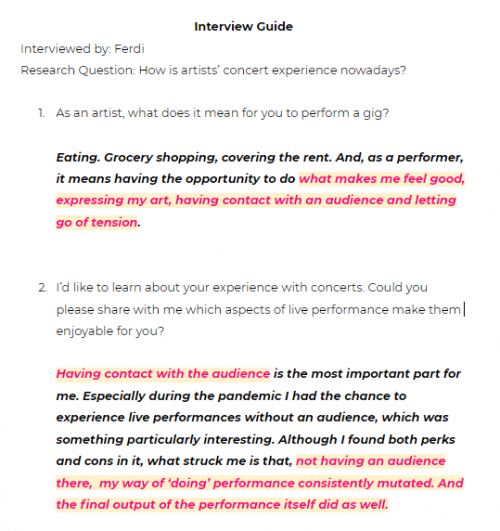 preview of an artist interview
| Users' perspective
|
Artists' perspective
|
|
interview period: 5th May 2021 - 14th May 2021
participants: 4
sample description: experienced in virtual music events (4)
|
motives behind taking or not taking a gig (virtually or live)
|
| impact of audience feedback in virtual and live settings
|
observation
overall five virtual music events have been visited and observed:
8th May 2021 - Shanghai Community Radio (SHCR)
10th May 2021 - xJazz festival
11th May 2021 - xJazz festival
14th May 2021 - xJazz festival
15th May 2021 - xJazz festival
plattforms


interpretation
IMAGE of the Joyce table
Personas


 implementation on google forms
 preview of an user interview
 preview of an artist interview


